


Introduction: Biochar and carbon storage
Biochar is a carbon-rich form of charcoal produced from organic biomass and primarily used to improve soil health and store carbon. It is also called horticultural charcoal or “black gold” for soils. It is mainly used in soils to:
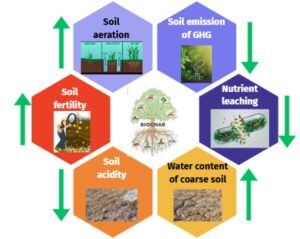
Biochar is one of the most durable carbon removal solutions, with the ability to lock away carbon for over 1,000 years. Unlike many traditional offset approaches, biochar combines permanent carbon sequestration with additional benefits such as soil regeneration, waste management and rural livelihood support. As companies face growing pressure to achieve credible net-zero targets, demand for high-quality carbon removal credits is increasing rapidly. However, the effectiveness of biochar projects depends on strong verification systems, additionality, and long-term environmental impact, making robust project design and monitoring essential.
Biochar is produced in two ways: artisanal and industrial.
- The artisanal approach is community-driven, where farmers convert crop residue into biochar using simple, low-cost systems such as conical pits or flame curtain kilns, often without machinery.
- Industrial biochar production uses large-scale reactors capable of processing 50–60 tonnes of biomass per day, enabling higher efficiency, standardized production, and large-scale carbon removal projects.
Pyrolysis: The science behind biochar
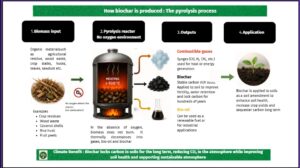
Biochar is produced through a process called pyrolysis, where organic material such as agricultural biomass is heated at high temperatures—typically above 500°C—in a low-oxygen environment. Because oxygen is absent, the biomass does not fully burn. Instead, it thermally decomposes into combustible gases, oils, and a stable carbon-rich material known as biochar. This stability is what makes biochar particularly important for climate action, as the carbon can remain locked in soils for hundreds or even thousands of years rather than returning quickly to the atmosphere as carbon dioxide.
India’s growing biochar ecosystem
One major development in India’s biochar sector came in 2025, when Google signed the world’s largest biochar carbon removal agreement under which it agreed to purchase 100,000 tonnes of carbon removal credits from a biochar project in Gujarat over five years.
The project developer proposes to establish six industrial biochar reactors, each capable of removing around 30 tonnes of CO₂ per day. The project highlights how biochar can simultaneously address waste management, ecosystem restoration, soil health, and durable carbon removal. The agreement also marked a major milestone for India’s carbon removal ecosystem, demonstrating growing global confidence in scalable, science-based climate solutions emerging from the country.
From Google’s perspective, the purchase of biochar-based credits is part of its broader strategy to achieve net-zero emissions while supporting solutions that can scale globally. The company views biochar as a promising pathway due to its measurable climate impact, scalability, cost-effectiveness and soil health benefits.
Beyond agriculture: Emerging applications
The applications of biochar extend beyond agriculture and carbon credits. Researchers at Indian Institute of Technology Guwahati have recently demonstrated how biochar made from pineapple crowns and mosambi fibres can be used to remove toxic pollutants from industrial wastewater. The study highlights how agricultural and food waste can be transformed into valuable environmental solutions through pyrolysis, reinforcing biochar’s potential in circular economy and pollution-control applications.
Concluding thoughts on India’s emerging biochar opportunity
Globally, biochar projects are increasingly demonstrating how carbon removal can be combined with ecosystem restoration, waste management and rural development.
- Aperam BioEnergia (Brazil): Converts forestry residues into large-scale carbon removal credits through industrial biochar production, supporting sustainable forest management.
- Pacific Biochar (North America): Uses biochar projects to support land restoration and community-driven climate initiatives by converting wood waste from sustainable forestry operations into biochar.
- Carboneers (Ghana): Transforms agricultural waste into biochar while improving soil fertility, reducing open burning and supporting rural job creation.
- Premier Forest Products (UK): Produces high-efficiency biochar through advanced pyrolysis systems for durable carbon storage by transforming wood waste into carbon-dense bricks.
- Carbo Culture (Global): Develops modular pyrolysis units designed for scalable deployment across multiple regions with a focus on urban and industrial waste streams.
These examples are particularly relevant for India, which possesses vast quantities of agricultural residue and biomass feedstock generated annually. With increasing corporate demand for high-integrity carbon removal credits, India has the potential to become a major hub for biochar-based carbon sequestration by transforming agricultural waste into long-term climate solutions while simultaneously supporting soil health, circular economy practices, and rural livelihoods.
Sources:
- Regreener – The 5 best biochar carbon credit and offset projects of 2026
- Trellis – How Google and an Indian startup struck the largest biochar carbon removal deal ever
- IIT Guwahati – Scientists use fruit waste to treat polluted wastewater